Will Layoffs Continue in 2027? Job Market Trends, AI Impact & Career Outlook
Key takeaways
- Will layoffs continue in 2027? Layoffs may continue in some industries due to economic uncertainty, automation, and business restructuring.
- AI and job layoffs: Artificial intelligence may automate repetitive tasks while creating opportunities in emerging technology fields.
- Industries facing potential risks: IT, banking, e-commerce, customer support, and manufacturing may experience workforce changes.
- Future of jobs in India: Hiring opportunities in 2027 will depend on economic growth, industry demand, and changing skill requirements.
- Job security in 2027: AI literacy, data analysis, communication, adaptability, and problem-solving can help professionals remain competitive.
- Career planning for students: Internships, practical experience, continuous learning, and career guidance can help students prepare for future employment opportunities.
- Hiring outlook for 2027: Some sectors may expand recruitment while others continue restructuring. The overall outlook remains uncertain.
Will Layoffs Continue in 2027? Job Market Trends, AI Impact & Career Outlook
Job layoffs have become a major concern for employees, fresh graduates, and students planning their careers. Many companies are changing their workforce strategies because of economic uncertainty, artificial intelligence, and evolving business needs.
These changes have raised an important question: Will layoffs continue in 2027?
Although layoffs may continue in certain industries, the overall employment outlook remains uncertain. Some companies may reduce their workforce, while others may create opportunities in emerging fields.
Understanding job market trends in 2027 can help students and professionals prepare for changing employment conditions.
This article explores possible layoff trends, the impact of AI, employment opportunities in India, and the skills needed for future careers.
Will Layoffs Continue in 2027?
Layoffs may continue in 2027, particularly in industries experiencing automation, restructuring, or financial pressure.
However, there is no reliable way to predict the exact number of job losses across all industries.
Companies make workforce decisions based on business performance, market demand, technology adoption, and economic conditions.
Some organisations may reduce certain roles while hiring employees with different skills.
For example, a company might automate repetitive administrative tasks while expanding its cyber security or data analytics teams.
Therefore, layoffs in 2027 may not affect every industry or profession equally.
The future job market will likely depend on how businesses balance technology, productivity, and workforce requirements.
Why Are Companies Reducing Their Workforce?
Understanding the reasons behind workforce reductions can help explain possible future employment trends.
Economic Uncertainty and Cost Reduction
Economic conditions influence hiring and workforce decisions.
When businesses face lower demand, rising expenses, or financial uncertainty, they may reduce operational costs.
Some organisations respond by delaying recruitment, restructuring departments, or reducing employee numbers.
However, cost reduction does not always involve layoffs. Companies may also limit new hiring or reduce spending in other areas.
Artificial Intelligence and Workplace Automation
Artificial intelligence is changing how organisations complete everyday tasks.
AI-powered tools can assist with data processing, customer support, content creation, and routine administrative activities.
As companies adopt these technologies, some job responsibilities may change or become less labour-intensive.
The relationship between AI and job layoffs is complex.
AI may reduce demand for certain tasks, but it can also create opportunities for employees who develop new technical and analytical skills.
Business Restructuring and Changing Skill Requirements
Companies regularly adjust their business models to remain competitive.
A business may close an under performing department, combine teams, or invest in new technologies.
These decisions can affect existing positions.
At the same time, employers may recruit professionals with skills that support their new business priorities.
This makes continuous learning increasingly important for employees.
What Do Recent Layoff Trends Tell Us About 2027?
Recent workforce changes provide useful context for understanding future employment risks.
However, past layoffs cannot determine exactly what will happen in 2027.
Global Layoff Trends in 2025 and 2026
During 2025 and 2026, workforce restructuring remained an important topic across the technology and business sectors.
Companies faced different pressures, including changing customer demand, operational costs, and investment in emerging technologies.
According to the World Economic Forum's Future of Jobs Report 2025, technological changes, economic conditions, and demographic shifts are expected to influence employment through 2030.
The report projects both job creation and displacement, highlighting the changing nature of employment.
It is important to distinguish between announced job cuts, completed layoffs, and general hiring slowdowns.
These indicators describe different employment conditions and should not be treated as identical.
Layoff Trends in India's IT and Technology Sector
India's technology sector is closely connected to global business demand.
IT services companies depend on spending by international clients across industries such as banking, retail, and healthcare.
Changes in client budgets and technology requirements can influence recruitment and workforce planning.
IT layoffs in India may therefore be affected by global economic conditions, automation, and business restructuring.
However, the industry also includes opportunities in cybersecurity, cloud computing, enterprise technology, and AI-related services.
What Current Employment Data Can and Cannot Predict
Employment reports can identify trends in hiring, skills, and workforce demand.
The Future of Jobs Report 2025 examines expected changes in employment and skills through 2030.
Such research helps explain long-term workforce transformation.
However, projections are not guaranteed.
Actual employment outcomes in 2027 will depend on economic developments, business investment, and technological adoption.
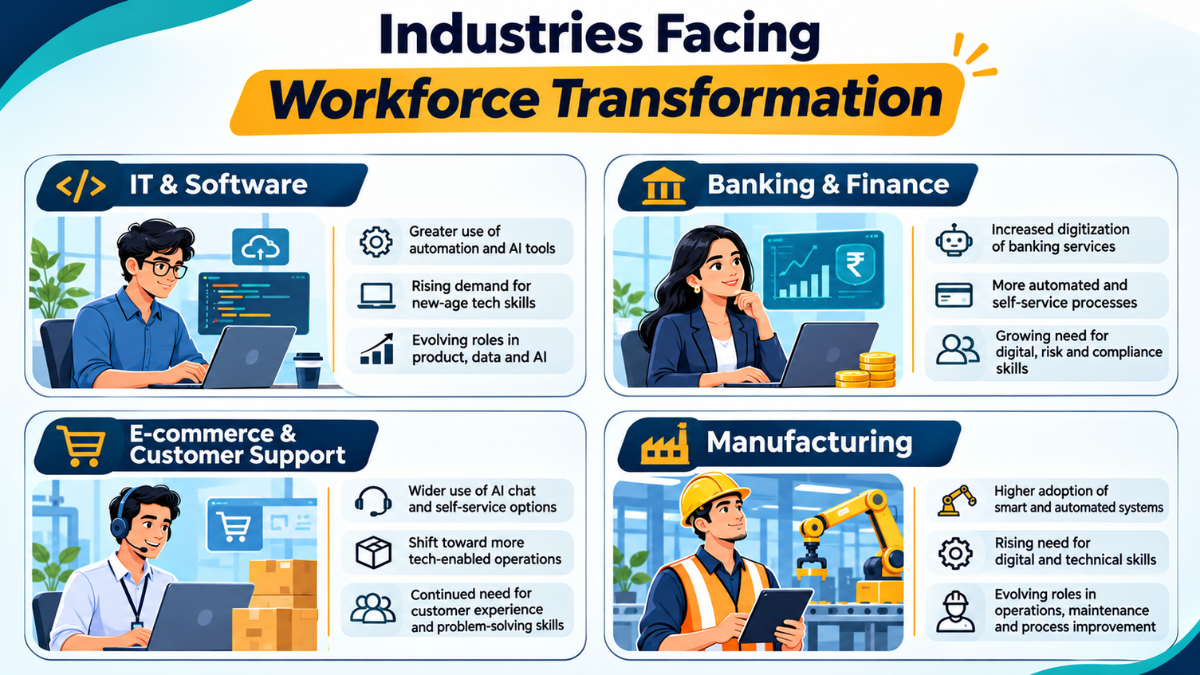
Which Industries Could Face Layoff Risks in 2027?
Some industries may experience greater workforce changes because of automation, restructuring, or changing consumer demand.
These are potential areas of exposure, not confirmed predictions of future layoffs.
Information Technology and Software Services
Technology companies are increasingly adopting AI-assisted development, automation, and cloud-based services.
Routine technical tasks may change as these tools become more capable.
However, demand may continue for professionals who can design, manage, secure, and improve complex technology systems.
Banking, Finance and Administrative Services
Banks and financial organisations use digital platforms to process transactions and manage customer services.
Automation may reduce the need for certain repetitive administrative activities.
At the same time, specialised roles involving financial analysis, compliance, cybersecurity, and risk management may remain important.
E-commerce, Startups and Customer Support
Startups and e-commerce businesses often adjust workforce size according to funding, revenue, and customer demand.
Customer support operations may also change as AI chatbots and automated systems handle routine enquiries.
However, complex customer issues still require human judgement and communication.
Manufacturing and Automation-Exposed Industries
Manufacturing companies continue to explore robotics, digital monitoring, and automated production systems.
These technologies can change workforce requirements.
Employees with technical maintenance, quality management, and advanced manufacturing skills may find opportunities as industrial processes evolve.
Will AI Replace Jobs or Create New Opportunities in 2027?
The AI impact on employment is one of the biggest questions surrounding the future job market.
Artificial intelligence can automate some tasks while creating demand for new capabilities.
Jobs and Tasks Most Exposed to AI Automation
Repetitive and predictable tasks are often more suitable for automation.
Examples include routine data entry, basic document processing, and certain customer service activities.
Research from the International Labour Organization indicates that approximately one in four jobs worldwide has some exposure to generative AI.
However, the research suggests that job transformation is more likely than complete replacement for most occupations.
Many jobs involve a combination of technical tasks, communication, judgement, and problem-solving.
Emerging Roles Linked to AI and Digital Transformation
AI adoption may support opportunities in areas such as:
- AI application development and implementation
- Data engineering and analytics
- Cybersecurity
- Cloud computing
- AI governance and technology risk
- Business process improvement
These roles require different levels of education, technical knowledge, and practical experience.
Students should explore actual job requirements before choosing a career pathway.
Why Human Skills Will Still Matter
Technology can process information quickly, but human skills remain valuable in many professional situations.
Communication, leadership, creativity, ethical judgement, and critical thinking support effective workplace decisions.
Employees who combine technical knowledge with interpersonal skills may be better prepared for changing job requirements.
What Will the Job Market in India Look Like in 2027?
The future of jobs in India will depend on domestic economic growth, business investment, technology adoption, and global market conditions.
Employment opportunities may expand in some sectors while slowing in others.
The Government of India's Periodic Labour Force Survey provides employment and unemployment indicators that help explain the country's labour market.
These indicators offer useful context, although they cannot predict exact hiring conditions in 2027.
Hiring Opportunities for Fresh Graduates
Fresh graduates may face competition when applying for entry-level positions.
Employers often evaluate practical skills, communication abilities, and relevant project experience alongside academic qualifications.
Internships, industry projects, and professional certifications can help graduates demonstrate their capabilities.
However, completing a certification does not guarantee employment.
Students who need support with academic and career decisions can explore higher education and career guidance through Ayushkar Education.
Changing Employer Expectations
Employers may increasingly value candidates who can adapt to new technologies and workplace processes.
Digital literacy, analytical thinking, and problem-solving are relevant across many industries.
Students should understand how their academic knowledge connects with practical workplace requirements.
Opportunities Beyond Traditional IT Roles
Technology-related employment is not limited to software development.
Students may explore opportunities in healthcare technology, digital business operations, logistics, financial technology, and education technology.
Career prospects vary according to qualifications, location, industry demand, and individual skills.
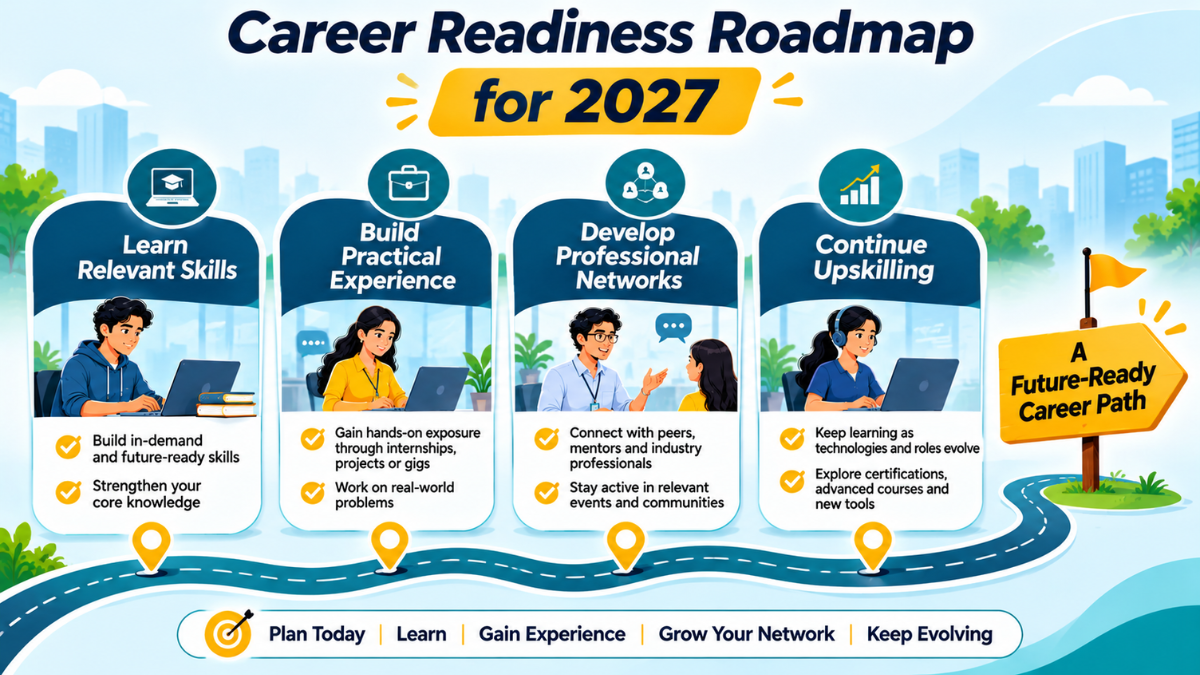
Which Skills Could Improve Job Security in 2027?
Developing relevant capabilities can help professionals adapt to workplace changes.
However, no qualification or skill can guarantee job security in 2027.
AI Literacy and Digital Skills
Understanding how AI tools work can be useful across different professions.
Students and employees can learn how to use digital tools responsibly and evaluate AI-generated information.
Basic digital literacy is becoming relevant beyond technology-focused careers.
Data Analysis and Problem-Solving
Organisations use data to understand customers, improve operations, and make decisions.
Employees who can interpret information and solve practical problems may contribute across different business functions.
These skills are useful in management, finance, marketing, technology, and other fields.
Communication, Adaptability and Critical Thinking
Technical expertise alone may not be enough in changing workplaces.
Employees also need to communicate clearly, collaborate with teams, and respond to unfamiliar challenges.
Critical thinking helps professionals assess information and make informed decisions.
Continuous Learning and Professional Development
Learning should continue beyond formal education.
Professionals can update their knowledge through recognised courses, practical projects, workshops, and workplace training.
Students and working professionals may also explore online degree programmes to develop academic knowledge while managing other responsibilities.
The skills in demand in 2027 may differ across industries, making ongoing career research important.
How Can Students and Professionals Prepare for Possible Layoffs?
Career preparation can help individuals respond more effectively to employment uncertainty.
The right approach depends on a person's education, experience, and career goals.
For College Students and Fresh Graduates
Students can begin preparing before completing their degrees.
Practical steps include developing industry-relevant skills, participating in internships, and building a portfolio of academic projects.
Choosing the right university can also support long-term career planning. Students should evaluate academic programmes and learning opportunities before making a decision.
Students should also improve communication skills and explore different career opportunities.
Effective career planning for students involves understanding personal interests alongside changing industry requirements.
For Working Professionals
Employees can regularly review their skills and professional development needs.
Learning new technologies, improving existing capabilities, and maintaining professional networks may support career flexibility.
Workers can also prepare financially by reviewing expenses and building emergency savings where possible.
These steps may reduce the difficulties associated with unexpected employment changes.
For Employees Considering a Career Change
Career transitions require careful planning.
Professionals should research new industries, understand qualification requirements, and identify transferable skills.
For example, an employee with business operations experience may explore opportunities in project coordination or business analysis.
Additional training or formal education may be useful depending on the target role.
Will Hiring Recover in 2027?
Hiring conditions in 2027 remain uncertain.
A stronger economy and increased business investment could support recruitment across several industries.
However, slower economic growth or continued restructuring could limit hiring in some sectors.
AI adoption may also change the types of positions companies offer.
Therefore, job market trends in 2027 should be evaluated using current employment data rather than assumptions.
Students and professionals should monitor industry developments and prepare for different employment scenarios.
Conclusion
Will layoffs continue in 2027? Some industries may experience further workforce reductions, but widespread layoffs are not inevitable.
Economic conditions, artificial intelligence, and changing business requirements will influence future employment opportunities.
For students and professionals, preparation is more useful than relying on uncertain predictions.
Developing relevant skills, gaining practical experience, and exploring different career pathways can improve adaptability.
Understanding employment trends can help individuals make informed education and career decisions.
Frequently Asked Questions
Will layoffs continue in 2027 in India?
Layoffs may continue in some Indian industries because of restructuring, automation, or economic pressures. However, their scale and timing cannot be predicted reliably.
Will IT layoffs increase in 2027?
IT layoffs could increase or decrease depending on global client demand, company performance, and technology adoption. There is no confirmed industry-wide forecast.
Is AI the main reason behind job layoffs?
AI is one factor influencing workforce changes. Economic conditions, business restructuring, financial performance, and changing customer demand also affect employment decisions.
Which jobs may be most affected by automation in 2027?
Jobs involving repetitive administrative, data-processing, and routine customer service tasks may experience changes. However, automation does not necessarily eliminate entire occupations.
Will fresh graduates face difficulty finding jobs in 2027?
Some graduates may face competition, depending on their field and local employment conditions. Practical skills, internships, and relevant experience can strengthen job applications.
Planning your next career move?
Connect with our education experts and make a confident decision about your future.