How to Choose an Online University in India: Essential Pre-Admission Tools and Checklist

Key takeaways
- University recognition and programme-specific entitlement should be verified before admission.
- Pre-admission tools help students compare universities, fees, eligibility and academic resources.
- NAAC accreditation and NIRF rankings provide additional institutional information but do not replace UGC-DEB verification.
- Students should compare the total programme cost rather than advertised tuition fees alone.
- Course curriculum, learning flexibility and academic support are important university selection factors.
- An online university admission checklist supports informed and organised decision-making.
Introduction
Online education has made higher education more accessible to students and working professionals across India. With universities offering flexible undergraduate and postgraduate programmes, learners can pursue academic qualifications without regularly attending a physical campus.
However, choosing the right institution requires careful research. University recognition, programme fees, eligibility requirements, academic quality and career support are important factors that influence the learning experience.
Understanding how to choose an online university in India can help students avoid unnecessary expenses and make informed educational decisions.
This guide explores essential pre-admission tools, verification methods and comparison techniques that students should use before enrolling in an online degree programme.
Why Pre-Admission Research Is Important
Selecting an online university involves investing time, money and effort in your future. Relying solely on advertisements, rankings or promotional offers may lead to unsuitable academic decisions.
Pre-admission research helps students:
Verify university and programme recognition.
Understand admission eligibility requirements.
Compare programme fees and scholarships.
Evaluate academic quality and learning flexibility.
Understand career development opportunities.
Avoid misleading admission and placement claims.
Proper research allows students to select a programme that matches their academic interests, budget and career objectives.
Essential Pre-Admission Tools for Online Universities
Several official platforms and digital resources help students evaluate universities independently. These tools provide information about recognition, accreditation, affordability and academic quality.
| Pre-Admission Tool | Purpose |
|---|---|
| UGC University Directory | Verify university recognition |
| UGC-DEB Portal | Check online programme entitlement |
| NAAC Accreditation Portal | Review institutional accreditation |
| NIRF Ranking Portal | Compare institutional performance |
| Eligibility Checker | Verify academic requirements |
| Fee Calculator | Estimate total education expenses |
| Scholarship Checker | Explore financial assistance |
| Curriculum Comparison Tool | Compare subjects and specialisations |
| LMS Demonstration | Evaluate the online learning experience |
| Career Research Tools | Explore career opportunities |
Using these resources together helps students develop a clearer understanding of their shortlisted universities. Not every university provides automated tools, so students can also use official brochures and personal spreadsheets.
How to Verify an Online University Before Admission
University verification should be the first step before selecting an online degree programme. A recognised university may not necessarily be entitled to offer every programme in online mode.
Students should follow these steps:
Visit the official University Grants Commission (UGC) website.
Search for the university in the official directory.
Verify its legal name and institutional category.
Check programme-specific recognition or entitlement.
Confirm the official admission website and payment channels.
These checks help students avoid unauthorised education providers and misleading admission offers.
How to Check UGC Approved Online Universities
Students searching for UGC approved online universities should verify both institutional recognition and programme-specific entitlement.
The University Grants Commission's Distance Education Bureau (UGC-DEB) provides information about institutions recognised or entitled to offer online and distance education programmes.
Steps to Check UGC-DEB Entitlement
Visit the official UGC-DEB portal.
Locate the recognised and entitled programmes section.
Select the relevant academic year and admission session.
Search for the university.
Verify the selected degree programme under online mode.
For example, students planning to pursue an online MBA should specifically verify the MBA programme rather than relying only on the university's general recognition.
Understanding UGC, NAAC and NIRF
| Organisation | Purpose |
|---|---|
| UGC-DEB | Online and distance programme recognition or entitlement |
| NAAC | Institutional quality assessment and accreditation |
| NIRF | Institutional ranking and performance comparison |
Students can visit the NAAC website and NIRF portal for additional institutional information.
However, a high NAAC grade or NIRF ranking does not replace programme-specific UGC-DEB verification.
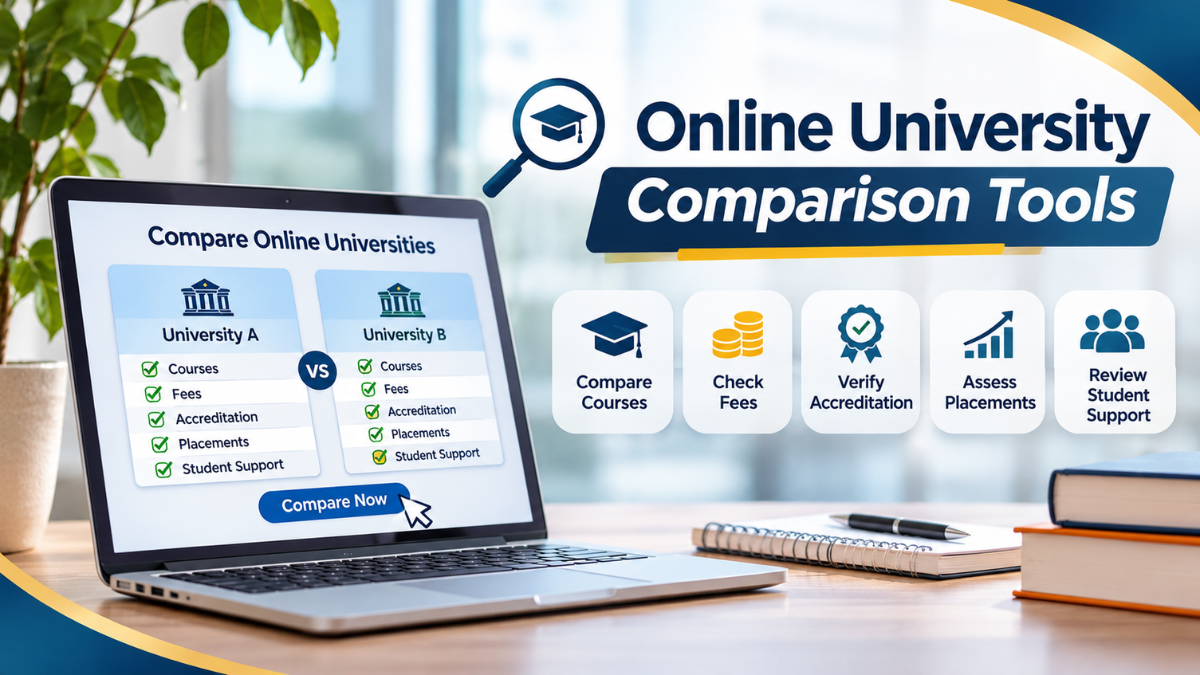
Online University Comparison Tools
Online university comparison tools help students evaluate multiple institutions based on their academic and financial requirements.
Students can use official university websites, programme brochures and spreadsheets to compare shortlisted institutions.
Sample University Comparison Template
| mparison Factor | University A | University B |
|---|---|---|
| UGC-DEB entitlement | Verify | Verify |
| Programme duration | Check | Check |
| Total programme fees | Compare | Compare |
| Course specialisations | Review | Review |
| Recorded lectures | Check | Check |
| Examination mode | Verify | Verify |
| Scholarship options | Explore | Explore |
| Career assistance | Review | Review |
Shortlisting three to five universities and comparing these factors can help students identify meaningful differences between programmes.
Instead of selecting an institution based on popularity, students should focus on the features that directly support their educational goals.
How to Use an Online Degree Eligibility Checker
An online degree eligibility checker helps students determine whether their academic qualifications meet programme-specific admission requirements.
Some universities provide eligibility checking facilities through their official admission portals. Students can also review published eligibility criteria or contact the university directly.
Minimum marks, subject combinations and other admission requirements vary across institutions.
An eligibility checker provides preliminary guidance, while final admission depends on official university requirements and document verification.
Online University Fee Comparison
Affordability is an important consideration when selecting an online degree. However, students should compare the complete programme cost rather than focusing only on advertised tuition fees.
An effective online university fee comparison includes tuition, registration charges, examination fees, certification expenses and applicable financing costs.
Sample Online Degree Fee Calculation
| Fee Component | University A | University B |
|---|---|---|
| Tuition fees | ₹1,00,000 | ₹1,10,000 |
| Registration fees | ₹2,000 | ₹1,000 |
| Examination fees | ₹8,000 | Included |
| Certification fees | ₹5,000 | Included |
| Total cost | ₹1,15,000 | ₹1,11,000 |
Although University A has lower tuition fees, University B has a lower overall cost in this hypothetical example.
Students should also explore scholarship opportunities, semester-wise payments, EMI conditions and refund policies.
Always request the latest official fee structure before making a financial commitment.
How to Perform an Online Degree Validity Check
An online degree validity check is essential before enrolling in any programme.
Under applicable UGC regulations, undergraduate and postgraduate degrees awarded through appropriately recognised or entitled online programmes are treated as equivalent to corresponding conventional degrees.
Students should verify:
Legal recognition of the university.
Programme-specific UGC-DEB entitlement.
Relevant academic admission session.
Degree-awarding institution.
Applicable professional and regulatory requirements.
Recognised online degrees may be used for higher education and employment applications, subject to the eligibility requirements of the respective institution or employer.
Students planning to study abroad or apply for government jobs should separately verify the relevant qualification acceptance criteria.

Factors to Consider When Choosing an Online University
Apart from recognition and affordability, several academic and personal factors influence the quality of online education.
1. Course Curriculum and Specialisations
Review semester-wise subjects, electives, practical projects and available specialisations. Choose a programme that aligns with your career interests and industry requirements.
2. Learning Management System (LMS)
A reliable learning platform makes it easier to access lectures, assignments and academic resources. Request a demonstration or sample lecture, where available, before enrolling.
3. Learning Flexibility
Check live-class schedules, recorded lecture availability and assignment deadlines. This is particularly important for working professionals managing employment alongside education.
4. Faculty and Academic Support
Understand how students can interact with faculty members, clarify doubts and receive academic or technical assistance.
5. Examination Methods
Verify examination formats, online proctoring requirements, assessment procedures and whether physical attendance is required.
6. Career and Placement Support
Review career counselling, resume development, interview preparation and recruitment assistance specifically available to online learners.
Placement assistance should not be confused with guaranteed employment.
7. Student Reviews
Explore feedback from current students and graduates across multiple sources to understand their experiences with academic quality, learning platforms and student services.
Things to Check Before Taking Online Admission
Before paying admission fees, students should carefully review all academic, financial and administrative requirements.
| Verification Factor | What to Check |
|---|---|
| University recognition | Official regulatory status |
| Programme entitlement | Selected online degree and session |
| Eligibility | Academic admission requirements |
| Programme fees | Complete cost of education |
| Examination process | Assessment and attendance requirements |
| Scholarships | Eligibility and applicable conditions |
| Refund policy | Cancellation and refund terms |
| Admission deadline | Official application schedule |
| Payment channel | Authorised university payment portal |
Students should avoid institutions or intermediaries that promise guaranteed jobs, demand immediate payments or refuse to provide official admission documents.
When in doubt, contact the university directly through its official communication channels.
Online University Admission Checklist
Use this checklist to complete essential verification before enrolling.
Verify university recognition and UGC-DEB entitlement.
Confirm programme eligibility and duration.
Review the curriculum and available specialisations.
Compare total programme fees.
Check scholarship and payment options.
Evaluate the learning platform and academic support.
Understand examination requirements.
Review career development services.
Read admission and refund policies.
Prepare academic and identity documents.
Create the required ABC ID and DEB-ID.
Confirm the official admission portal.
Save payment receipts and admission confirmation.
Completing this checklist can help students reduce uncertainty and avoid common admission mistakes.
Conclusion
Understanding how to choose an online university in India is essential for making an informed higher education decision.
By using pre-admission tools, students can verify university recognition, compare programme fees, evaluate eligibility and understand the academic experience before enrolling.
The right university should offer a recognised programme that aligns with the student's interests, financial circumstances and career objectives.
At Ayushkar Education, we encourage students and parents to explore educational opportunities, compare institutions carefully and make informed decisions about their academic futures.
Frequently Asked Questions
How do I choose an online university in India?
Verify programme recognition, compare fees, review eligibility requirements and evaluate curriculum, learning flexibility and academic support.
How can I verify an online university?
Visit the official UGC and UGC-DEB websites to check institutional recognition and programme-specific entitlement for the relevant admission session.
Are recognised online degrees valid in India?
Yes. Degrees awarded through appropriately recognised or entitled online programmes are valid under applicable UGC regulations.
What tools help students compare online universities?
UGC-DEB verification portals, NAAC accreditation resources, NIRF rankings, eligibility checkers, fee calculators and comparison spreadsheets are useful resources.
Is NAAC accreditation enough to verify an online degree?
No. Students must separately verify the specific online programme through the UGC-DEB portal.
Do online universities guarantee placements?
Some universities provide placement assistance and career development services. However, employment depends on qualifications, practical skills, experience and employer requirements.
Comparing universities?
Connect with our education experts and make a confident decision about your future.