India Skills Report 2026: Employability Trends, Skill Gaps and Career Opportunities
Key takeaways
- The India Skills Report 2026 records an overall employability figure of 56.35% among assessed candidates.
- Employability reflects assessed workforce readiness rather than actual employment.
- Technical and interpersonal skills complement academic qualifications.
- AI, data analytics, cloud computing and cybersecurity are prominent skill areas.
- Practical learning and industry exposure can strengthen career preparation.
- Continuous skill development remains important across educational disciplines.
- Students should select academic programmes based on their interests, abilities and long-term career objectives.
Introduction
India's employment landscape is undergoing a significant transformation as artificial intelligence, digitalisation, automation and emerging business models reshape industry requirements. Academic qualifications remain important, but employers increasingly value practical knowledge, technical proficiency, communication skills and adaptability.
According to the India Skills Report 2026, overall employability among assessed candidates has increased to 56.35%, compared with 54.81% in the previous edition. This improvement highlights progress in workforce readiness while emphasising the importance of addressing existing skill gaps.
For students, graduates and educational institutions, understanding these developments is essential for making informed academic decisions, developing industry-relevant capabilities and preparing for emerging career opportunities.
What Is the India Skills Report 2026?
The India Skills Report 2026 is the 13th edition of an annual study examining workforce readiness, employability, industry expectations and changing employment patterns in India.
The report was released by ETS in collaboration with organisations including the Confederation of Indian Industry (CII), All India Council for Technical Education (AICTE), Association of Indian Universities (AIU) and Taggd.
It incorporates assessments from more than 100,000 candidates through the Global Employability Test (GET), along with industry inputs.
The report explores several important areas:
- Employability across educational disciplines
- Emerging technical skill requirements
- Changing recruitment practices
- Artificial intelligence and workforce transformation
- Freelancing and gig employment
- Remote working and entrepreneurship
- Industry-academia collaboration
These findings provide valuable insights for students preparing to enter an increasingly technology-driven employment market.
Official reference: India Skills Report 2026 – Complete Report
Key Findings of India Skills Report 2026
The report highlights the growing relationship between education, skill development and changing workforce requirements.
| Key Indicator | Findings |
|---|---|
| Overall employability | 56.35% |
| Previous edition employability | 54.81% |
| Improvement in employability | 1.54 percentage points |
| Candidates assessed | More than 100,000 |
| Prominent employability states | Uttar Pradesh, Maharashtra and Karnataka |
| Emerging skill areas | AI, data analytics, cloud computing and cybersecurity |
| Important workforce trends | Flexible work, digital transformation and AI-supported roles |
Note: The findings suggest that students should focus on developing practical capabilities alongside academic knowledge to prepare for evolving industry expectations.
Understanding India's Employability Rate in 2026
The India employability rate 2026 reflects an improvement in the proportion of assessed candidates meeting the report's employability benchmark.
The progression from 54.81% to 56.35% indicates gradual improvement in assessed workforce readiness.
However, employability and employment are different concepts.
- Employability refers to an individual's knowledge, skills and readiness to participate in the workforce.
- Employment refers to an individual's actual participation in paid work or other recognised employment activities.
The report's employability figure represents candidates scoring above 60% in the Global Employability Test. It does not mean that 56.35% of India's total population or graduates are employed.
Understanding this distinction is important when interpreting employment-related statistics.
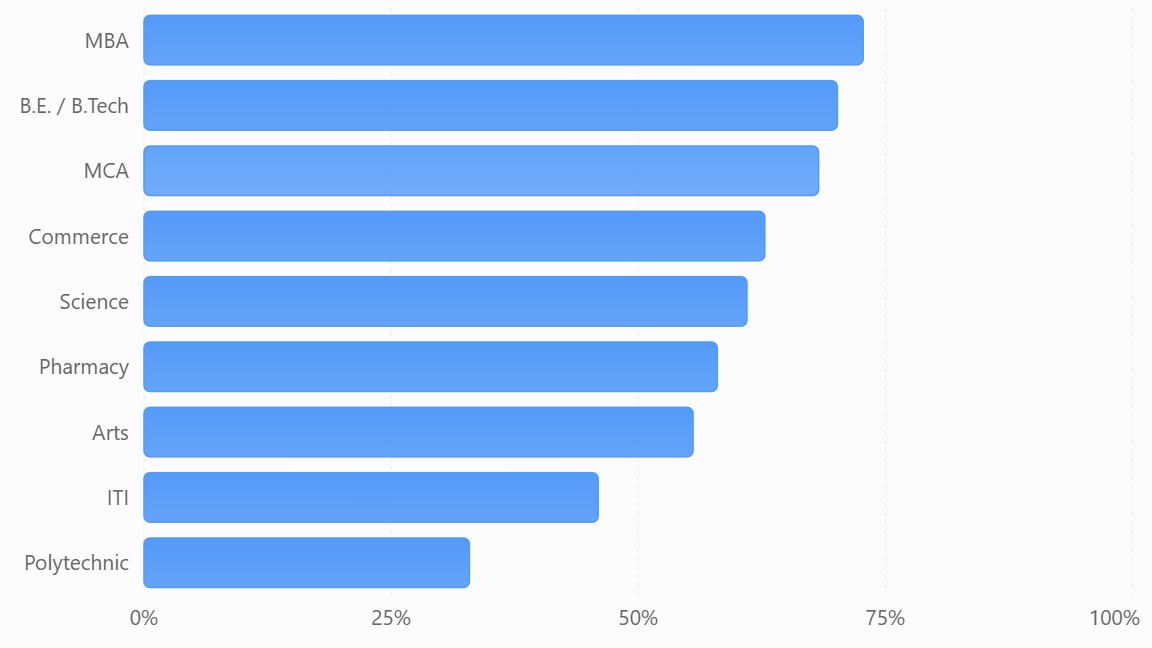
Graduate Employability in India
Graduate employability in India varies across educational qualifications and academic disciplines. Differences in curriculum, practical exposure, technical knowledge and assessment performance can influence workforce readiness.
The India Skills Report 2026 presents the following qualification-wise employability figures.
Source: India Skills Report 2026, Page 86.
These figures highlight differences in assessment outcomes across educational qualifications. However, they should not be interpreted as guaranteed placement rates or used as the sole basis for selecting a degree.
Students should also consider their interests, academic strengths, programme quality and long-term career objectives.
Major Skill Gaps in India in 2026
Addressing the skill gap in India in 2026 remains important for improving the transition from education to employment.
As industries adopt new technologies and business practices, students need opportunities to translate theoretical knowledge into practical capabilities.
1. Limited Practical Industry Exposure
Students may possess academic knowledge but have limited opportunities to apply it in professional environments.
Internships, laboratory activities, apprenticeships and industry projects can help bridge this gap.
2. Technical Skill Gaps
Rapid technological developments create demand for specialised capabilities in programming, automation, data analysis and digital systems.
Regular skill development can help students remain aligned with emerging industry requirements.
3. Communication and Interpersonal Skills
Professional success often requires effective communication, teamwork, presentation abilities and collaboration.
Students should develop these capabilities alongside technical expertise.
4. Digital Literacy
Modern workplaces increasingly rely on digital applications, collaborative platforms, cloud services and data-driven processes.
Developing digital proficiency is relevant across engineering, commerce, healthcare and management disciplines.
5. Problem-Solving and Critical Thinking
Employers require professionals who can analyse information, understand complex problems and develop practical solutions.
Project-based learning and case studies can help students strengthen these abilities.
6. Adaptability and Continuous Learning
Changing job roles and technologies require individuals to update their knowledge throughout their careers.
A willingness to learn and adapt can support long-term professional development.
Most In-Demand Skills in India in 2026
Understanding the most in-demand skills in India in 2026 can help students identify learning opportunities aligned with their academic interests and professional goals.
The following technical areas reflect prominent workforce developments discussed in the report.
| Skill Area | Technical Focus | Potential Career Roles |
|---|---|---|
| Artificial Intelligence and Machine Learning | Intelligent systems, programming and predictive models | AI Engineer, ML Engineer |
| Data Analytics | Data interpretation, SQL and visualisation | Data Analyst, Business Analyst |
| Cloud Computing | Cloud infrastructure and distributed systems | Cloud Engineer, Cloud Administrator |
| Cybersecurity | Information protection and security monitoring | Security Analyst, Security Engineer |
| Software Development | Programming, application development and testing | Software Developer, Application Developer |
| FinTech | Digital payments and financial technology | FinTech Analyst, Software Developer |
| Sustainability | Renewable energy and environmental management | Sustainability Analyst, Energy Engineer |
| Healthcare IT | Digital healthcare systems and medical data | Health Informatics Specialist, Healthcare Data Analyst |
Students should combine relevant technical capabilities with human skills such as communication, creativity, adaptability and ethical decision-making.
Essential Employability Skills for Students
Developing employability skills for students involves more than gaining technical knowledge. It requires a combination of professional, analytical and interpersonal capabilities.
Important skills include:
- Effective communication
- Critical thinking and analytical reasoning
- Teamwork and collaboration
- Digital literacy
- Time management
- Leadership and initiative
- Emotional intelligence
- Problem-solving abilities
- Professional ethics
- Adaptability and continuous learning
These transferable skills are valuable across academic disciplines and professional environments.
Students can strengthen them through academic projects, extracurricular activities, presentations, internships and collaborative learning.
Industries Creating Future Job Opportunities in India
The changing employment landscape is creating new responsibilities and specialised roles across multiple industries.
Students exploring future job opportunities in India can consider sectors that align with their interests and educational qualifications.
Information Technology and Artificial Intelligence
AI-enabled systems, software development, cloud infrastructure and digital transformation are influencing technology-related career pathways.
Potential roles include:
- AI Engineer
- Software Developer
- Data Scientist
- Cloud Engineer
- Cybersecurity Analyst
Banking, Financial Services and Insurance
Digital banking, financial analytics and automated financial services are reshaping the BFSI sector.
Potential roles include:
- Financial Analyst
- Risk Analyst
- FinTech Specialist
- Digital Banking Specialist
Manufacturing and Automation
Industrial automation, smart manufacturing and connected production systems require interdisciplinary engineering knowledge.
Potential roles include:
- Robotics Engineer
- Automation Engineer
- Industrial Engineer
- Embedded Systems Engineer
Healthcare and Medical Technology
Digital healthcare, medical devices and health information systems connect healthcare knowledge with technological capabilities.
Potential roles include:
- Biomedical Engineer
- Healthcare Data Analyst
- Health Informatics Specialist
- Clinical Research Associate
Renewable Energy and Sustainability
The transition towards sustainable energy systems creates opportunities for professionals interested in environmental science, engineering and energy management.
Potential roles include:
- Renewable Energy Engineer
- Environmental Engineer
- Sustainability Consultant
- Energy Analyst
These career roles are illustrative educational pathways rather than guaranteed job openings.
Role of Artificial Intelligence in Workforce Transformation
Artificial intelligence is influencing how organisations analyse information, automate routine activities and support decision-making.
Its applications extend beyond information technology into healthcare, education, banking, marketing, manufacturing and transportation.
For students, AI literacy is becoming increasingly relevant regardless of academic background.
Engineering students can explore AI development and automation, while commerce students can learn about financial analytics and business intelligence. Healthcare students can examine applications of AI in medical information systems and clinical decision support.
Understanding AI also requires awareness of data privacy, responsible technology usage, accuracy and ethical considerations.
Rather than depending entirely on automated tools, students should develop the ability to evaluate information and apply technology responsibly.
Changing Employment Models in India
The India Skills Report 2026 also examines how flexible employment arrangements are influencing workforce participation.
Gig Economy and Freelancing
Project-based assignments allow professionals to apply specialised skills across different organisations and industries.
Freelancing opportunities can include software development, graphic design, digital marketing, consulting and content creation.
Remote and Hybrid Work
Digital collaboration tools enable certain professionals to work from different locations.
Communication, independent task management and digital proficiency are particularly important in these work environments.
Entrepreneurship
Entrepreneurship provides an alternative pathway for individuals interested in developing products, services or innovative business solutions.
Students can explore entrepreneurship through college incubation centres, research projects and startup-related learning programmes.
While flexible work offers opportunities, students should also consider income stability, professional responsibilities and career development.
Role of Skill Development in Higher Education
Skill development in higher education plays an important role in preparing students for changing workforce requirements.
Universities and colleges can help address employability challenges by connecting academic learning with practical industry applications.
Important initiatives include:
- Industry-oriented curriculum development
- Internship and apprenticeship programmes
- Project-based learning
- Technical laboratories and research facilities
- Industry-academia partnerships
- Professional certification opportunities
- Entrepreneurship and incubation support
- Career counselling and placement training
- Digital learning and interdisciplinary education
Institutions that combine theoretical knowledge with practical learning can provide students with opportunities to develop relevant professional capabilities.
When selecting a university, students should evaluate academic quality, curriculum relevance, practical learning facilities, industry exposure and available career support.
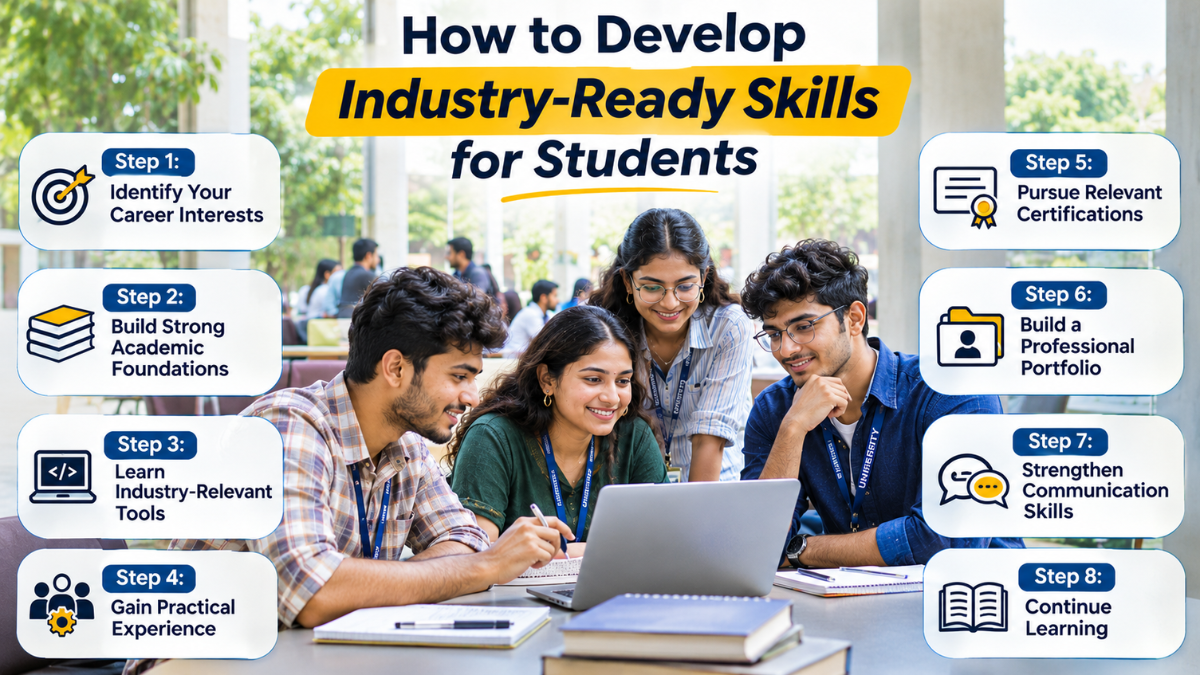
How to Develop Industry-Ready Skills for Students
Developing industry-ready skills for students requires consistent learning, practical application and career planning.
Step 1: Identify Your Career Interests
Understand your strengths, academic interests and preferred industries before selecting a professional pathway.
Step 2: Build Strong Academic Foundations
Develop a clear understanding of the fundamental concepts associated with your chosen academic discipline.
Step 3: Learn Industry-Relevant Tools
Explore technical applications, software platforms and professional tools relevant to your intended career.
Step 4: Gain Practical Experience
Participate in internships, academic projects, workshops, competitions and research activities.
Step 5: Pursue Relevant Certifications
Professional certifications and structured online courses can complement academic qualifications when selected according to specific learning objectives.
Step 6: Build a Professional Portfolio
Document academic projects, internships, research activities, technical achievements and practical experience.
Step 7: Strengthen Communication Skills
Practise presentations, professional writing, interviews and collaborative problem-solving.
Step 8: Continue Learning
Stay informed about changes in your chosen industry and regularly update your knowledge.
This approach can help strengthen job readiness among Indian graduates and support their transition into professional environments.
Government Initiatives Supporting Skill Development
Students can explore several government-supported learning and skill development platforms to strengthen their academic and professional capabilities.
| Initiative or Platform | Purpose |
|---|---|
| Skill India Digital Hub | Access to skill development and learning opportunities |
| National Skill Development Corporation (NSDC) | Workforce skill development and training initiatives |
| SWAYAM | Online academic and professional learning |
| NPTEL | Technology, engineering, science and management courses |
| National Career Service (NCS) | Career information and employment-related services |
| National Apprenticeship Training Scheme (NATS) | Practical apprenticeship training opportunities |
| AICTE Internship Portal | Internship discovery and industry exposure |
Note: Students should check the respective official websites for current programme availability, eligibility requirements and application procedures.
Future Employability Trends in India
Employability trends in India in 2026 indicate the growing importance of combining academic knowledge with practical, digital and interpersonal capabilities.
Several areas are likely to influence future workforce requirements:
- AI-supported professional roles
- Skills-based recruitment
- Interdisciplinary career opportunities
- Continuous professional development
- Sustainable technology and green skills
- Digital and remote collaboration
- Industry-integrated education
- Entrepreneurship and innovation
- Micro-credentials and specialised certifications
As job roles evolve, students who build strong academic foundations and remain open to continuous learning may be better prepared to navigate changing professional environments.
Conclusion
The India Skills Report 2026 highlights the importance of connecting education with workforce expectations. While the improvement in assessed employability to 56.35% reflects progress, addressing skill gaps and expanding practical learning opportunities remain essential.
For students, academic qualifications provide an important foundation, while technical expertise, communication abilities, industry exposure and continuous learning can strengthen career readiness.
Choosing an academic programme should therefore involve understanding personal interests, educational opportunities and changing professional requirements.
At Ayushkar Education, we encourage students to explore educational pathways, develop relevant skills and make informed academic decisions aligned with their long-term career goals.
Frequently Asked Questions
What is the India Skills Report 2026?
The India Skills Report 2026 is an annual study examining employability, workforce readiness, skill requirements and employment-related developments in India.
Does the employability rate represent the employment rate?
No. Employability measures assessed readiness for work, whereas employment refers to actual participation in employment.
Which educational qualification has the highest employability in the report?
Among the broad educational qualifications presented in the report's qualification-wise table, MBA graduates recorded 72.76%, followed by B.E./B.Tech graduates at 70.15%. These results do not guarantee employment or placement outcomes.
How can students improve their employability?
Students can improve career readiness through academic learning, internships, practical projects, relevant certifications, communication skills and continuous professional development.
Does a high employability rate guarantee a job?
No. Employment outcomes also depend on individual skills, qualifications, experience, recruitment requirements, job availability and performance during selection processes.
Planning your next career move?
Connect with our education experts and make a confident decision about your future.