Cybersecurity Careers in India: Courses, Skills & Job Opportunities

Key takeaways
- Cybersecurity careers in India span multiple industries and technical specializations.
- Students can pursue relevant courses in Computer Science, Information Technology, Cybersecurity, and related disciplines.
- Ethical hacking, cloud security, digital forensics, and digital risk management offer different career pathways.
- Networking, programming, operating systems, and analytical thinking are valuable foundational skills.
- Certifications, internships, and authorized practical projects can support career preparation.
- Continuous learning is important because digital technologies and security threats evolve over time.
Introduction
From online banking and digital payments to cloud computing and artificial intelligence, digital technology has become an essential part of everyday life. As businesses, educational institutions, healthcare organizations, and government agencies increasingly rely on digital systems, protecting sensitive information has become more important than ever.
Cybersecurity careers in India offer diverse opportunities for students interested in technology, digital security, and problem-solving. From ethical hacking and cloud security to digital forensics and risk management, cybersecurity professionals play an important role in protecting digital infrastructure.
However, building a career in cybersecurity requires the right education, technical knowledge, practical experience, and continuous learning.
This article explores cybersecurity courses, essential skills, career opportunities, and how students can prepare for a future in digital security.
What Is Cybersecurity?
Cybersecurity refers to the practices, technologies, and processes used to protect computer systems, networks, applications, and digital information from unauthorized access, cyberattacks, damage, and disruption.
Cybersecurity professionals identify potential threats, assess security vulnerabilities, monitor digital systems, and help organizations respond to security incidents.
The major areas of cybersecurity include:
- Network Security: Protecting computer networks from unauthorized access and cyber threats.
- Application Security: Identifying and reducing security vulnerabilities in software applications.
- Cloud Security: Protecting cloud-based applications, infrastructure, and data.
- Ethical Hacking: Conducting authorized security assessments to identify vulnerabilities.
- Digital Forensics: Examining digital evidence related to cybersecurity incidents.
- Digital Risk Management: Identifying, assessing, and managing technology-related risks.
Each specialization requires a different combination of technical knowledge, analytical skills, and practical experience.
Why Digital Security Skills Matter
As organizations adopt digital technologies, they face security challenges such as phishing, ransomware, data breaches, identity theft, and unauthorized access.
Cybersecurity skills help organizations protect their information, maintain business operations, and reduce technology-related risks.
Some important benefits of cybersecurity include:
- Protecting personal and business information.
- Identifying security vulnerabilities.
- Improving the reliability of digital services.
- Preventing unauthorized access to sensitive systems.
- Supporting incident detection and response.
- Reducing financial and operational risks.
Students can visit the Indian Computer Emergency Response Team (CERT-In) website to explore cybersecurity advisories, security awareness resources, and information about emerging cyber threats.
Developing digital security knowledge is valuable not only for cybersecurity professionals but also for students pursuing other technology-related careers.
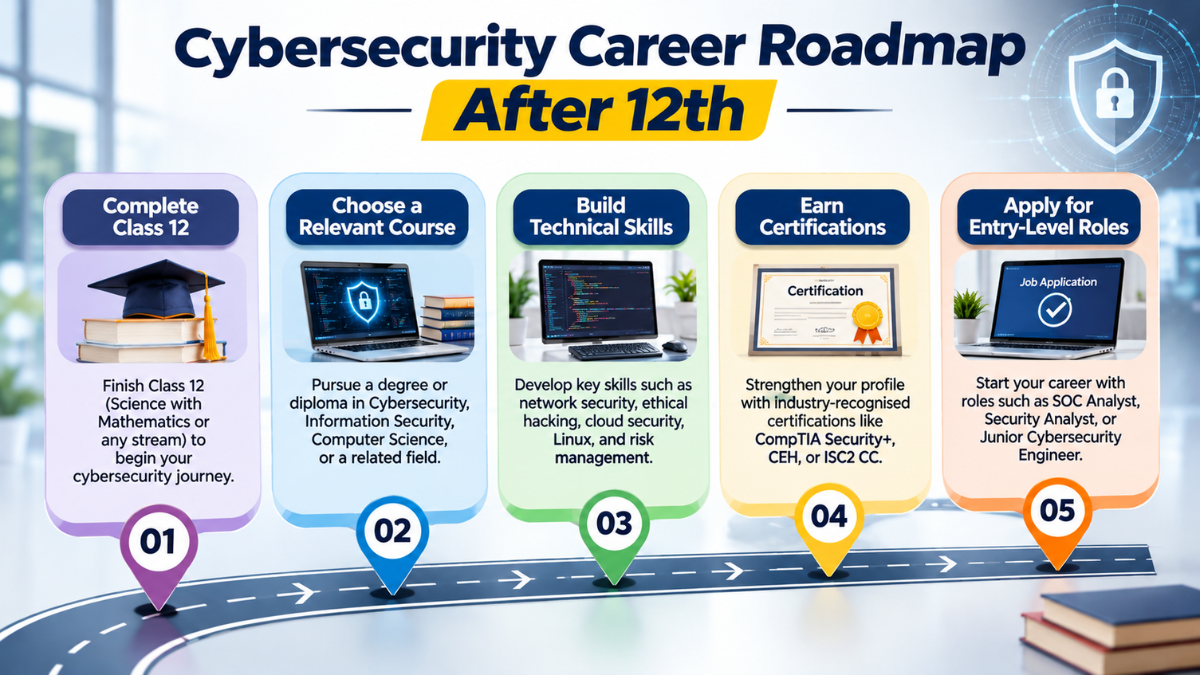
Cybersecurity Courses After 12th
Students interested in cybersecurity can explore undergraduate programmes that provide strong foundations in computer science, networking, programming, and information security.
Several cybersecurity courses after 12th can help students develop the knowledge required to enter this field.
| Course | Key Learning Areas |
|---|---|
| B.Tech in Computer Science and Engineering | Programming, algorithms, operating systems, and computer networks |
| B.Tech in Cybersecurity | Network security, cryptography, ethical hacking, and cyber defence |
| B.Tech in Information Technology | Information systems, networking, and software development |
| Bachelor of Computer Applications (BCA) | Programming, databases, networking, and computer applications |
| B.Sc. in Computer Science | Computing fundamentals, algorithms, and software systems |
| B.Sc. in Cybersecurity | Information security, digital forensics, and security fundamentals |
| B.Sc. in Information Technology | Information systems, networking, and IT infrastructure |
Students do not necessarily need a degree specifically titled cybersecurity to pursue a career in digital security. Computer Science, Information Technology, and related disciplines can also provide relevant educational foundations.
Students can explore different computer science and engineering courses after 12th before selecting a suitable academic pathway.
Students who need guidance in selecting a suitable degree or university can explore the education and admission guidance services offered by Ayushkar Education.
Eligibility for Cybersecurity Courses
Eligibility requirements vary depending on the course, university, and admission process.
- Students applying for undergraduate programmes generally need to complete Class 12 from a recognized board.
- B.Tech programmes commonly have mathematics and science-related subject requirements.
- Eligibility for BCA and B.Sc. programmes varies across institutions.
- Some universities may require entrance examinations or institution-specific admission assessments.
Students should review the official admission guidelines and understand the engineering admission eligibility criteria before applying.
Essential Cybersecurity Skills for Students
Developing technical knowledge and analytical abilities is an important part of preparing for cybersecurity careers.
The following cybersecurity skills for students can provide a strong foundation for future specialization.
1. Computer Networking
Understanding how computer networks operate is essential for many cybersecurity roles.
Students should learn about network protocols, IP addresses, DNS, routing, firewalls, and secure communication.
2. Programming and Scripting
Programming helps cybersecurity professionals understand software behaviour, automate tasks, and investigate security issues.
Languages and scripting tools such as Python, JavaScript, Bash, and PowerShell can be useful depending on the chosen specialization.
3. Operating Systems
Knowledge of Linux and Windows operating systems helps students understand system configurations, access permissions, security settings, and monitoring processes.
4. Information Security Fundamentals
Students should understand basic security concepts such as encryption, authentication, access control, vulnerabilities, and threat detection.
5. Cloud Computing
As organizations use cloud-based infrastructure, understanding cloud computing, identity management, access permissions, and secure configurations can support career development.
6. Analytical Thinking and Problem-Solving
Cybersecurity professionals often investigate suspicious activities, assess risks, and identify solutions to complex security challenges.
Strong analytical thinking, attention to detail, communication, and teamwork are valuable professional skills.
Students can explore relevant computer science, networking, and information security courses through NPTEL to strengthen their technical knowledge.
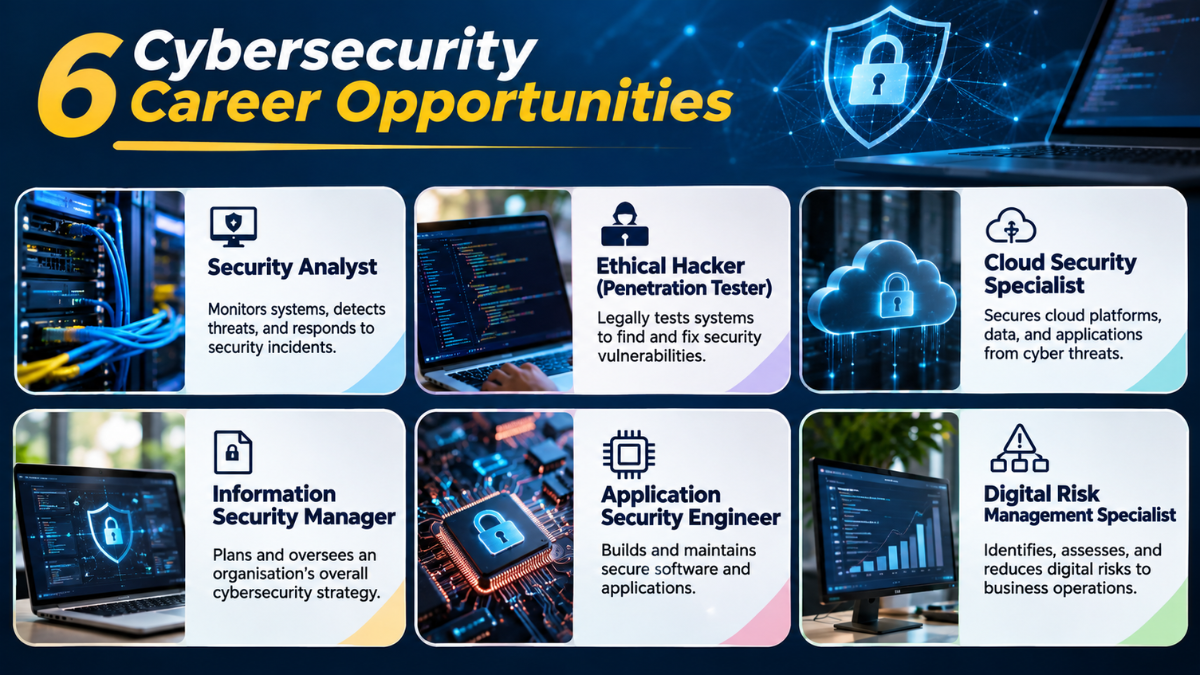
Top Cybersecurity Careers in India
Cybersecurity is a multidisciplinary field offering several career pathways. Students can explore different cybersecurity career opportunities based on their interests, educational qualifications, and technical skills.
| Job Role | Key Responsibilities | Relevant Skills |
|---|---|---|
| Cybersecurity Analyst | Monitor systems and identify security threats | Network security and threat analysis |
| Ethical Hacker | Conduct authorized security assessments | Security testing and vulnerability assessment |
| Cloud Security Engineer | Protect cloud infrastructure and applications | Cloud computing and identity management |
| SOC Analyst | Monitor security alerts and investigate incidents | Security monitoring and log analysis |
| Digital Forensics Analyst | Examine digital evidence and security incidents | Forensic analysis and evidence handling |
| Digital Risk Analyst | Assess technology-related risks | Risk assessment and compliance |
| Network Security Engineer | Protect network infrastructure | Networking and firewall management |
| Application Security Engineer | Identify and reduce software security vulnerabilities | Programming and application security |
Note: These roles have different entry requirements. Some positions may be accessible to graduates with relevant skills, while others require specialized training or professional experience.
Ethical Hacking Careers in India
Ethical hacking is a specialized area of cybersecurity that focuses on identifying vulnerabilities through authorized security testing.
Ethical hackers help organizations understand security weaknesses and recommend improvements before those weaknesses are exploited by malicious attackers.
Students interested in ethical hacking careers in India should develop knowledge of:
- Computer networking
- Linux operating systems
- Web application security
- Programming and scripting
- Vulnerability assessment
- Security testing principles
Potential career roles include Ethical Hacker, Penetration Tester, Vulnerability Assessment Analyst, and Security Consultant.
Students must understand that ethical hacking requires explicit authorization. Security testing should only be performed within approved environments and agreed legal boundaries.
Cloud Security Careers
Cloud computing enables organizations to store information, run applications, and manage computing resources through cloud-based platforms.
These environments require appropriate security measures to protect sensitive information and prevent unauthorized access.
Students exploring cloud security careers can develop skills in:
- Cloud computing fundamentals
- Identity and access management
- Secure cloud configurations
- Data protection and encryption
- Cloud security monitoring
- Infrastructure security
Potential career opportunities include Cloud Security Analyst, Cloud Security Engineer, Cloud Security Consultant, and Cloud Security Architect.
Advanced roles, such as Cloud Security Architect, generally require substantial technical knowledge and professional experience.
Digital Risk Management Careers
Cybersecurity is not limited to programming and technical security testing. Digital risk management focuses on identifying, evaluating, and managing risks associated with technology and digital operations.
Students interested in digital risk management careers can explore areas such as information security governance, compliance, technology risk assessment, and security policy development.
Potential job roles include:
- IT Risk Analyst
- Information Security Compliance Analyst
- Governance, Risk and Compliance (GRC) Analyst
- Technology Risk Consultant
- Information Security Auditor
These careers may be suitable for students interested in combining technology knowledge with business processes, analytical thinking, documentation, and risk management.
How to Become a Cybersecurity Professional
Students wondering how to become a cybersecurity professional can follow a structured learning pathway that combines academic education with practical experience.
Step 1: Choose a Relevant Educational Pathway
Explore undergraduate programmes in Computer Science, Information Technology, Cybersecurity, or related disciplines.
Students should compare course curricula, laboratory facilities, faculty expertise, and practical learning opportunities before selecting an institution.
Understanding how to compare universities in India can help students make more informed educational decisions.
Step 2: Build Strong Technical Fundamentals
Develop foundational knowledge in programming, networking, operating systems, databases, and information security.
These concepts provide a foundation for learning advanced cybersecurity topics.
Step 3: Choose a Cybersecurity Specialization
Explore different areas of cybersecurity and identify a specialization that matches your interests.
Students may choose ethical hacking, cloud security, digital forensics, security operations, application security, or risk management.
Step 4: Gain Practical Experience
Participate in authorized cybersecurity laboratories, workshops, academic projects, internships, and beginner-friendly security challenges.
Practical learning helps students understand how theoretical concepts are applied in real-world situations.
Step 5: Explore Relevant Certifications
Professional certifications and structured learning programmes can help students develop specialized knowledge and demonstrate their understanding of cybersecurity concepts.
However, certifications should complement academic education and practical experience rather than replace them.
Step 6: Build a Professional Portfolio
Students can document academic projects, security assessments conducted in authorized environments, technical reports, and relevant learning achievements.
A professional portfolio can help demonstrate practical knowledge and problem-solving abilities when applying for internships and entry-level positions.
Students looking to develop specialized knowledge can explore cybersecurity certifications for beginners alongside their academic studies.
| Certification or Learning Programme | Focus Area |
|---|---|
| ISC2 Certified in Cybersecurity (CC) | Cybersecurity fundamentals and security principles |
| CompTIA Security+ | Network security, threats, vulnerabilities, and security operations |
| Cisco Certified Support Technician (CCST) Cybersecurity | Foundational cybersecurity and security operations |
| Google Cybersecurity Professional Certificate | Security fundamentals, networking, Linux, and security analysis |
| Microsoft Security, Compliance, and Identity Fundamentals (SC-900) | Security, compliance, and identity management fundamentals |
Note: Students should check the official certification providers for current availability, examination fees, eligibility requirements, recommended experience, and certification renewal policies.
Useful learning resources include:
While certifications can support professional development, employers may also evaluate educational qualifications, practical skills, experience, and problem-solving abilities.
Industries Offering Cybersecurity Jobs in India
Cybersecurity professionals can work across industries that depend on digital infrastructure, online services, and information systems.
Several sectors offer potential cybersecurity jobs in India, including
| Industry | Cybersecurity Applications |
|---|---|
| Banking and Finance | Digital transaction security, fraud prevention, and financial data protection |
| Information Technology | Application security, network security, and security operations |
| Healthcare | Patient information protection and medical system security |
| E-commerce | Customer information and payment security |
| Telecommunications | Communication networks and infrastructure protection |
| Manufacturing | Industrial automation and operational technology security |
| Government and Public Services | Digital infrastructure and information security |
| Education | Student data protection and secure digital learning platforms |
Students can explore career information and available employment opportunities through the National Career Service (NCS) portal.
The availability of cybersecurity jobs depends on industry requirements, location, qualifications, technical skills, and professional experience.
Future Scope of Cybersecurity in India
The future scope of cybersecurity in India is closely connected to the continued adoption of digital technologies across industries.
Cloud computing, artificial intelligence, digital payments, connected devices, and automated systems introduce new security challenges that organizations must address.
Several areas are particularly relevant to the future of cybersecurity:
Artificial Intelligence and Cybersecurity
AI can support security monitoring, threat detection, and incident analysis. At the same time, AI-based systems introduce additional security and privacy considerations.
Cloud Security
Organizations using cloud-based infrastructure require appropriate security controls, identity management, and data protection practices.
Internet of Things (IoT) Security
Connected devices used in homes, industries, healthcare, and transportation require security measures to reduce unauthorized access and system vulnerabilities.
Digital Privacy and Risk Management
Protecting personal information and managing technology-related risks remain important responsibilities for organizations.
Industrial Cybersecurity
As manufacturing and industrial operations adopt automation and connected systems, protecting operational technology becomes increasingly important.
Students interested in emerging technologies can also explore career opportunities in robotics and automation to understand how engineering, intelligent systems, and digital security can intersect.
Cybersecurity is a continuously evolving field. Students who develop strong technical fundamentals, practical experience, and adaptability may be better prepared to pursue emerging career opportunities.
Conclusion
Cybersecurity has become an important part of the digital world, offering diverse career pathways for students interested in technology, security, and analytical problem-solving.
From ethical hacking and cloud security to digital forensics and risk management, the field provides opportunities to explore different technical and professional specializations.
Students considering cybersecurity careers in India should focus on choosing a suitable educational pathway, strengthening technical fundamentals, gaining practical experience, and developing relevant professional skills.
With the right education, practical knowledge, and continuous learning, students can prepare for a future in digital security and contribute to building safer digital environments.
At Ayushkar Education, we encourage students to explore educational and career pathways that align with their interests, abilities, and long-term goals.
Frequently Asked Questions
Is cybersecurity a good career option in India?
Cybersecurity is a career option worth exploring for students interested in technology, digital security, and problem-solving. Career opportunities exist across several industries, although employment prospects depend on qualifications, skills, experience, and market conditions.
Is coding necessary for cybersecurity?
Coding is useful in many cybersecurity roles, particularly ethical hacking, application security, and security automation. However, some risk management, governance, and compliance roles may require less programming expertise.
What is the difference between cybersecurity and ethical hacking?
Cybersecurity is a broad field focused on protecting digital systems, networks, and information. Ethical hacking is a specialized activity within cybersecurity that involves authorized security testing to identify vulnerabilities.
Can BCA students pursue cybersecurity careers?
Yes. BCA students can pursue cybersecurity careers by developing relevant knowledge in networking, programming, operating systems, and information security through academic projects, specialized training, and practical experience.
Which industries hire cybersecurity professionals?
Cybersecurity professionals may find opportunities in banking, information technology, healthcare, telecommunications, e-commerce, manufacturing, education, and government organizations.
Planning your next career move?
Connect with our education experts and make a confident decision about your future.