College Fees, Scholarships & Financial Aid in India

Key takeaways
- College Fees in India: Tuition fees vary depending on the course, institution, location, and facilities. Government colleges are generally more affordable than private institutions.
- Scholarships for Students in India: Government and private scholarships help eligible students reduce their higher education expenses.
- Popular Scholarship Schemes: Students can explore PM-USP, Reliance Foundation, Aditya Birla, Kotak Kanya, and other scholarship programmes.
- Scholarship Eligibility Criteria: Most scholarships consider academic performance, family income, course enrolment, and specific eligibility requirements.
- Scholarship Application Process: Students should check official websites, prepare the required documents, and apply before the deadlines.
- Financial Aid Options: Education loans, tuition fee waivers, and institutional assistance can help students manage college expenses.
- Smart College Selection: Compare course fees, scholarship opportunities, placement records, and overall education costs before choosing a college.
Introduction
Higher education is an important investment in a student's future. However, understanding college fees and scholarships in India is essential before choosing a college or university. Tuition fees, accommodation, books, and other expenses can make higher education costly for many families.
Fortunately, several scholarships for students in India are available through government schemes, private organisations, and educational institutions. These programmes help eligible students manage education expenses and pursue their preferred courses.
Whether you are planning to study engineering, medicine, management, arts, or commerce, this guide covers college fees in India, popular scholarships, eligibility requirements, application procedures, and financial aid options.
Understanding College and University Fees in India
College fees vary depending on the institution, course, location, and facilities. Students should compare university fees and scholarships before selecting an institution to understand the total cost of their education.
Government vs Private College Fees
Government colleges generally offer more affordable education because they receive financial support from central or state governments. Their tuition fees are often lower than those of private institutions.
Private colleges usually charge higher fees to support infrastructure, faculty, laboratories, and campus facilities. However, many private universities also provide scholarships and tuition fee concessions to eligible students.
Factors Affecting College Fees
Several factors influence college tuition fees in India:
- Course type: Professional programmes such as medicine, engineering, and management often have higher fees.
- Institution: Government, private, and deemed universities follow different fee structures.
- Location: Living expenses may be higher in metropolitan cities.
- Facilities: Hostel accommodation, laboratories, transportation, and other services can increase the overall cost.
Students should consider both academic quality and affordability when comparing colleges.
Course-Wise College Fees in India
Course fees in India differ significantly across institutions and programmes. The following table provides illustrative annual tuition fee ranges to help students understand potential expenses
| Course | Government College (Annual) | Private College (Annual) |
|---|---|---|
| B.Com | ₹1,000 to ₹40,000 | ₹20,000 to ₹3,00,000 |
| BCA | ₹5,000 to ₹50,000 | ₹50,000 to ₹2,50,000+ |
| BBA | ₹10,000 to ₹50,000 | ₹50,000 to ₹5,00,000+ |
| B.Sc | ₹5,000 to ₹25,000 | ₹50,000 to ₹2,00,000 |
| M.Com | ₹3,000 to ₹40,000 | ₹30,000 to ₹3,50,000+ |
| MCA | ₹4,000 to ₹1,50,000 | ₹50,000 to ₹3,00,000+ |
| MBA | ₹20,000 to ₹2,00,000 | ₹3,00,000 to ₹9,00,000+ |
| M.Sc | ₹1,000 to ₹50,000 | ₹70,000 to ₹4,00,000+ |
Note: These are indicative annual college fees in India. Actual fees may vary depending on the institution, course, location, and additional charges.
Note: The above figures are indicative annual college fees in India. Actual fees may vary depending on the institution, location, course specialization, and additional charges such as hostel, examination, and laboratory fees.
For Online courses Visit : Ayushkar Education
Types of Scholarships Available in India
Education scholarships in India help eligible students reduce their financial burden. Scholarships are generally awarded based on academic merit, financial need, or specific eligibility conditions.
Government Scholarships in India
Government scholarships for students are offered by central and state authorities. These programmes support eligible students from different educational and financial backgrounds.
| Scholarship Name | Scholarship Amount | Offered By | Who Can Apply | Eligibility Criteria | Official Website |
|---|---|---|---|---|---|
| PM-USP Central Sector Scholarship (CSSS) | ₹12,000/year for the first 3 years; ₹20,000/year for eligible later years | Ministry of Education, Government of India | UG and PG students | Above the 80th percentile in Class 12 board examinations; annual family income up to ₹4.5 lakh; regular courses | NSP |
| Prime Minister's Scholarship Scheme (PMSS) | ₹36,000/year for girls; ₹30,000/year for boys | Kendriya Sainik Board, Ministry of Defence | Eligible wards and widows of ex-servicemen and specified Armed Forces personnel | Generally at least 60% in the minimum educational qualification; admission to an eligible professional degree programme | KSB |
| National Scholarship for Post Graduate Studies | ₹15,000/month for 10 months annually, up to 2 years | University Grants Commission (UGC) | First-year postgraduate students | Below 30 years of age; first regular, full-time PG degree; additional selection conditions apply | NSP |
| National Scholarship for Higher Education of ST Students | Tuition and eligible academic expenses, with allowances subject to scheme limits | Ministry of Tribal Affairs | Eligible Scheduled Tribe students | Admission to a notified institution; annual family income up to ₹6 lakh | Ministry of Tribal Affairs |
| Karnataka State Scholarships | Varies by scheme; examples include ₹2,000 and ₹5,000 annual awards | Government of Karnataka | Eligible students studying in Karnataka | Depends on the specific scholarship, academic performance, course, and institution | Department of Collegiate Education |
Private Scholarships in India
Private scholarships in India are provided by companies, charitable foundations, and non profit organisations. Many focus on students with strong academic performance who also require financial assistance.
Scholarship Name | Scholarship Amount | Offered By | Who Can Apply | Eligibility Criteria | Official Website |
Reliance Foundation Undergraduate Scholarship | Up to ₹2,00,000 over the degree | Reliance Foundation | First-year UG students | Minimum 60% in Class 12; family income below ₹15 lakh/year; full-time degree | |
Aditya Birla Scholarship | ₹1.5–3 lakh/year (indicative) | Aditya Birla Group | Students at selected IIMs, IITs, BITS Pilani and law institutions | Admission to participating institutions; academic merit and selection process | |
Kotak Kanya Scholarship | Up to ₹1.5 lakh/year | Kotak Education Foundation | Female students pursuing professional UG courses | Academic merit, financial need and applicable income limits | |
J.N. Tata Endowment Loan Scholarship | Amount varies | J.N. Tata Endowment | Indian students pursuing PG studies abroad | Recognised degree, academic merit and selection requirements | |
Narotam Sekhsaria Scholarship | Interest-free loan up to ₹20 lakh | Narotam Sekhsaria Foundation | Indian PG students | Generally under 30 years; strong academic record and eligible PG admission | |
Panasonic Ratti Chhatr Scholarship | ₹70,250/year (indicative) | Panasonic Life Solutions India | Eligible undergraduate students | Academic merit, financial need and course-specific conditions | |
Santoor Women's Scholarship | ₹24,000/year (indicative) | Wipro Consumer Care and Wipro Cares | Eligible female students | State-specific eligibility, academic qualifications and financial criteria | |
Virtusa Engineering Excellence Scholarship | ₹50,000 (one year, indicative) | Virtusa | Eligible engineering students | Academic merit and programme-specific requirements | |
JK Tyre Shiksha Sarthi Scholarship | Up to ₹25,000 (one-time, indicative) | JK Tyre & Industries | Students in eligible programme categories | Academic performance and track-specific eligibility | |
HDFC Bank Parivartan ECSS Programme | Up to ₹75,000 | HDFC Bank | Eligible school, UG and PG students | Generally minimum 55% marks; income and financial-need criteria |
Merit-Based and Need-Based Scholarships
Merit-based scholarships recognise academic achievements, while need-based scholarships support students from financially disadvantaged families.
Students can also explore higher education scholarships offered directly by universities, including tuition fee waivers and institutional grants.
Scholarship Eligibility Criteria and Required Documents
Scholarship eligibility criteria vary depending on the scheme. Most providers consider academic performance, family income, course enrolment, and other specific conditions.
Common documents include:
- Academic marksheets and certificates
- Aadhaar or another accepted identity document
- College admission confirmation
- Family income certificate, if required
- Bank account details
Category or domicile certificate, where applicable
Students should carefully check the document requirements before applying. Incomplete applications or incorrect information may delay verification.
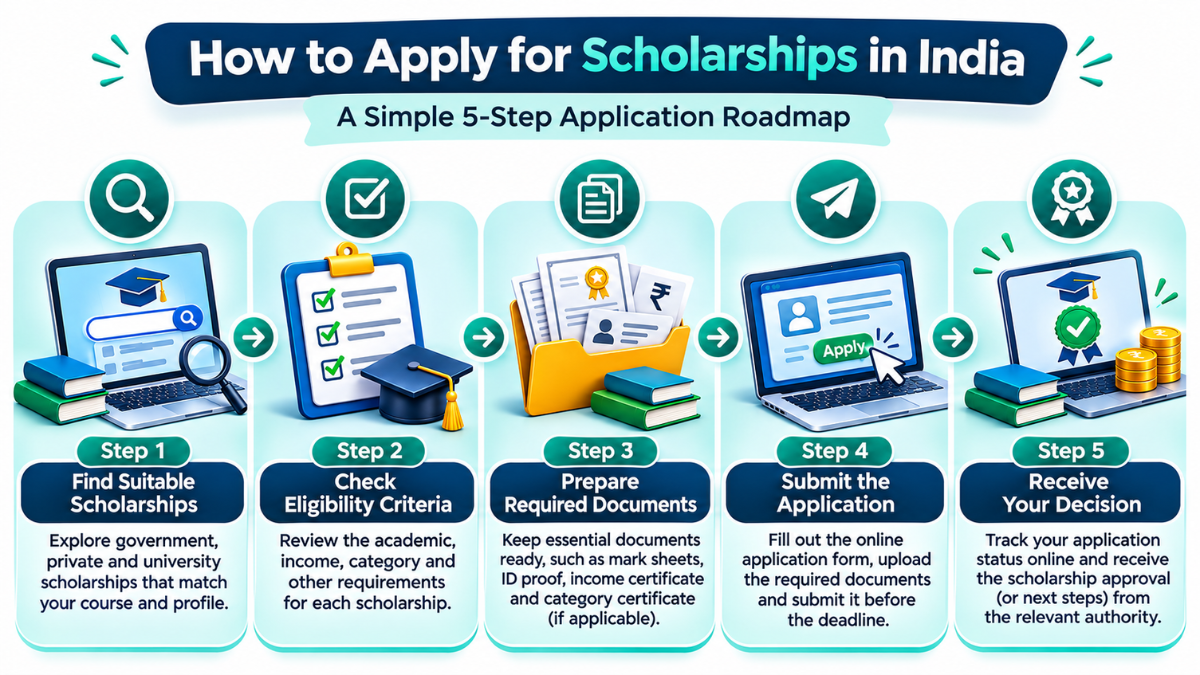
How to Apply for Scholarships in India
Understanding the scholarship application process helps students avoid common mistakes and submit applications on time.
Step 1: Find suitable scholarships
Visit the National Scholarship Portal, university websites, or official private scholarship portals. Shortlist programmes matching your academic qualifications and financial background.
Step 2: Check eligibility
Review the course requirements, income limits, academic criteria, and application deadlines.
Step 3: Complete the application
Register on the relevant portal and provide accurate personal, academic, and banking information.
Step 4: Upload required documents
Submit clear copies of all necessary certificates and supporting documents.
Step 5: Track application status
Save the application reference number and regularly check the portal for verification updates.
Students should apply before the deadline and avoid submitting incorrect or incomplete information.
Education Loans and Other Financial Aid Options
Apart from scholarships, financial aid for students in India is available through education loans, tuition fee waivers, and institutional assistance programmes.
Education Loans
Banks and eligible financial institutions provide education loans for recognised courses. Depending on the loan terms, funding may cover tuition fees, accommodation, books, and other approved expenses.
Students should compare interest rates, repayment periods, collateral requirements, and processing charges before applying.
Fee Waivers and Financial Assistance
Some colleges offer partial or full tuition fee waivers based on merit, family income, or institutional policies.
Eligible students may also explore government-supported interest subsidy schemes and other education funding programmes.
Combining suitable financial assistance with careful budgeting can make higher education more manageable.

Tips to Choose an Affordable College in India
Choosing an affordable college requires more than comparing tuition fees. Students should evaluate the overall value of their education.
Compare total expenses: Include tuition, hostel charges, transportation, books, and other costs.
Explore scholarships: Check government schemes, private scholarships, and institutional financial aid.
Review placement opportunities: Compare internships, placement records, and career support services.
Check recognition: Confirm that the college and program meet the relevant regulatory requirements.
Plan your budget: Estimate the complete course cost and identify suitable funding options before admission.
A well-planned college decision can help students balance educational quality with financial affordability.
Conclusion
Understanding college fees and scholarships in India helps students make informed higher education decisions. From comparing course fees to exploring government scholarships, private funding, and education loans, several options can make college more affordable.
Students should research their preferred institutions, review scholarship eligibility requirements, and verify information through official websites.
With the right financial planning, students can pursue their academic goals while managing education expenses effectively.
Frequently Asked Questions
What are the average college fees in India?
College fees depend on the course, institution, location, and admission category. Government colleges generally have lower tuition fees, while private institutions may charge more.
Which scholarships are available for students in India?
Students can explore government scholarships, private scholarships, university merit scholarships, and need-based financial assistance programmes.
How can I apply for government scholarships?
Eligible students can apply through the National Scholarship Portal or relevant state scholarship websites by submitting the required information and documents.
Are scholarships available for undergraduate and MBA students?
Yes. Several government, private, and institutional programmes support undergraduate students. MBA students can also explore scholarships and financial aid offered by management institutions.
What documents are required for scholarship applications?
Common requirements include academic marksheets, identity proof, admission confirmation, income certificates, and bank details. Exact requirements vary by scheme.
Working out the cost of your degree?
Connect with our education experts and make a confident decision about your future.